
Operations Support
Less chaos. More clarity & growth.
As businesses grow, processes become more complex, communication becomes scattered and founders often find themselves carrying more operational responsibility than they should. Operations Support is designed for growing businesses that need more structure, visibility and consistency behind the scenes, so the teams can work more effectively and founders can focus on leading the business.
Browse the services options below to learn more.

Operations Foundation
Build the operational backbone your business needs.
For businesses where growth has started creating operational chaos.
We'll focus on things like:
Workflow reviews & improvements
SOP documentation
Process mapping
Project management setup
Client onboarding/offboarding
Team communication
Operational organization
Ideal for businesses that need structure before they scale.

Operations Partnership
An embedded operational partner for growing businesses.
For founders who want someone owning operations instead of constantly reacting to them.
Support may include:
Ongoing operational oversight
Team coordination
Project management
Process optimization
Documentation maintenance
Client experience improvements
Executive support where needed
Strategic operational planning
Ideal for businesses looking for a long-term operational partner.
You can choose from two options depending on your business needs
Monthly retainer
Best for: Businesses looking for long-term operational support and stability.
Dedicated monthly operational support
Tailored scope based on your business needs
Regular communication and priority planning
Flexible month-to-month partnership
One-time project
Best for: Businesses needing focused operational improvements within a defined timeframe.
Examples include:
SOP creation
Workflow mapping
CRM implementation
ClickUp / Asana setup
AI & automation projects
Operational audits
Projects are delivered within an agreed scope and timeline, with clear documentation and handover at completion.
One-time project examples
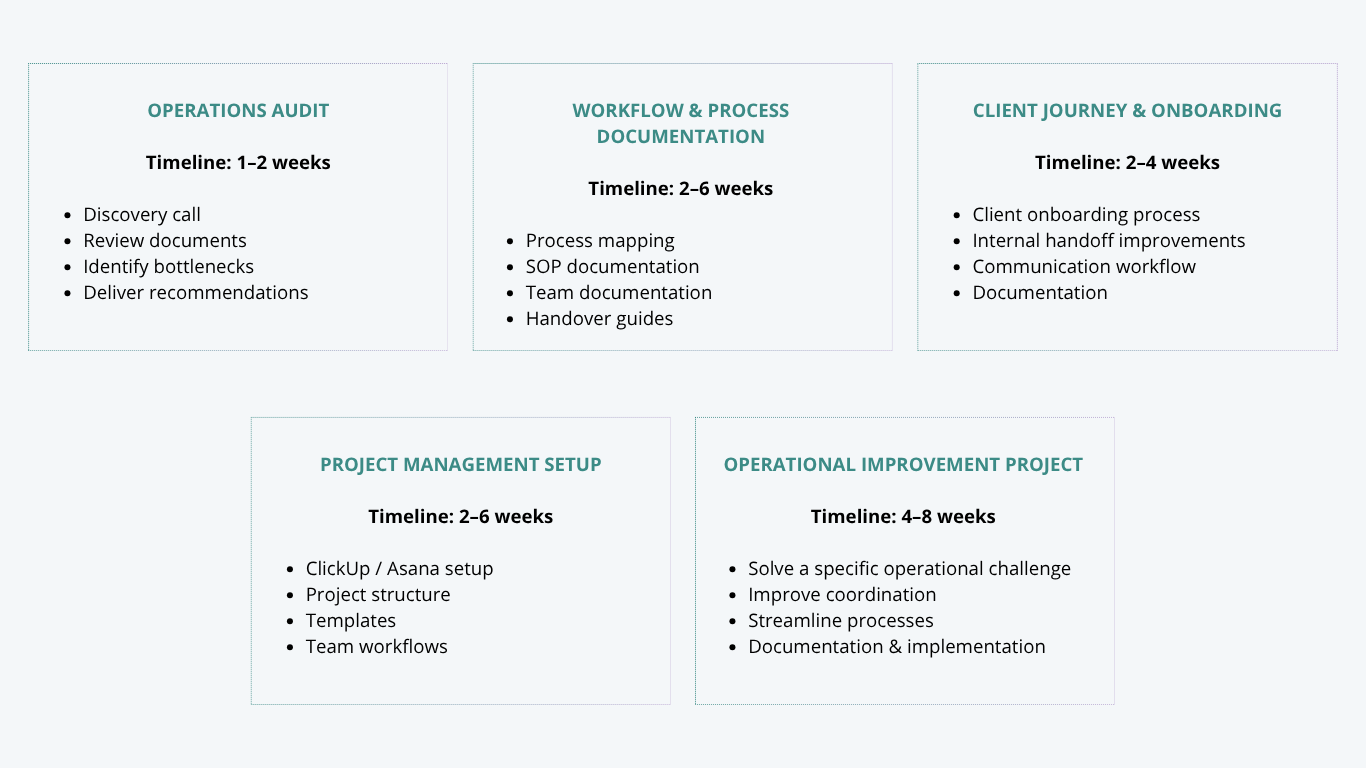
Every project is unique. The examples above illustrate the types of operational improvements we can work on together, while timelines vary depending on your business and the scope of the project.
Systems & Automations

Available exclusively to Operations Foundation and Operations Partnership clients.
Practical systems and automation support are designed to help growing businesses reduce repetitive work, improve workflows, and create smoother day-to-day operations. The focus is on simple, effective solutions that support the way your business already works without unnecessary complexity or overengineering.
Not every operational challenge requires automation though. The goal is to introduce these by looking into where they create a meaningful improvements, reduce manual work and support existing workflows without adding unnecessary complexity.
How it works
Every business operates differently, so systems and automation support is tailored based on operational needs, existing workflows, and project complexity.
Examples of Systems & Automations that can be done:
Client onboarding workflow setup and automation
Organizing team communication and coordination workflows
CRM organization and practical workflow improvements
Reducing repetitive manual tasks
Simple integrations between existing tools
AI-assisted operational support where useful
Automation always follows operations - not the other way around.

Operations Support may be a good fit if...
✓ You're spending too much time coordinating day-to-day operations
✓ Communication and information are spread across multiple tools
✓ Processes exist, but they're not consistently followed
✓ Growth is creating more complexity than your current systems can handle
✓ Your team relies heavily on you for updates and decisions
✓ You feel like you're constantly reacting instead of working proactively